UPPER WEST SIDE HISTORY
  • Home
  • Events
    • Upcoming Events
    • Past Events
  • Blogs
  • bulletins/exhibits
    • Bulletins
    • EXHIBITS
  • Buildings
    • Building Database
  • Library Collection
  • Resources
    • BNHG Book Collection
    • Sources of Historical Information
    • Useful Links and Resources
    • Paterno Archive
    • Bookshelf
    • 2020 Project
    • NYT articles about Manhattan Valley from 1865- 1998
    • Past Exhibits
    • Upper West Side History Quiz
    • BNHG BUILDING RESEARCH GUIDE
  • CONTACT
    • DONATE
    • Contact Us
    • MISSION STATEMENT
    • ABOUT US
    • Planning Group, BNHG

BLOGS

THE RISE AND TRAGIC FALL OF A MODEL WHO BROKE THE RULES

8/8/2023

1 Comment

 
Written by Marjorie Cohen, member of the Bloomingdale Neighborhood Planning Committee

​The centerpiece for the Straus Park triangle at 106
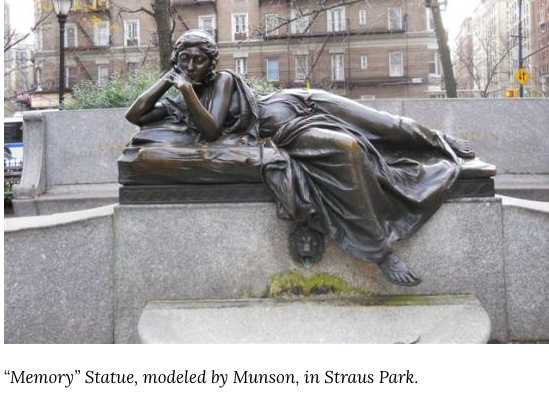
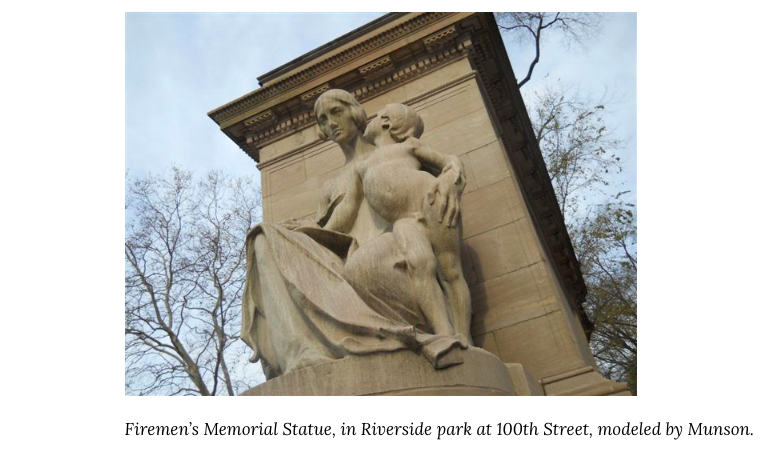
th Street and Broadway is a  statue, dedicated to the memory of Ida and Isador Straus who went down on the Titanic three years before, is a likeness of the face and form of a model named Audrey Munson. Other West Side statues that Audrey modeled for are the Firemen’s Memorial in Riverside Park at 100th Street and the memorial to the USS Maine in Columbus Circle. Her story is extraordinary.
Picture
​Born in a small town in upstate New York in 1891, Audrey Munson became an internationally famous model and muse for the most important sculptors of the American Beaux Arts movement. Her face and body were considered the ideal of American beauty; she was widely known as “The American Venus”. She is the woman who posed for the statue of Civic Fame on top of the Municipal Building, the U.S.S. Maine Monument at Columbus Circle, the statue of Abundance on top of the Pulitzer Fountain in front of the Plaza and hundreds of other extraordinary pieces of art in this city and others around the U.S. Three quarters of the sculptures created for the Pacific International Exposition in 1915 are modeled on Audrey’s figure and face.

But her story is far from a happy one. It involves a meteoric rise to fame as an artist’s model,  a brief career in silent films as the first woman to appear nude on screen, a stint as a newspaper columnist, involvement in a murder case, banishment back to upstate New York, a suicide attempt and finally, commitment to a mental hospital at the age of 39  where she lived until her death at 105.

In a newspaper column that Audrey wrote in 1921 when her fame was waning, she poses this plaintive  question: “What becomes of the artists’ models? I am wondering if many of my readers have not stood before a masterpiece of lovely sculpture or a remarkable painting of a young girl, her very abandonment of draperies accentuating rather than diminishing her modesty and purity, and asked themselves the question, ‘Where is she now, this model who was so beautiful?’”

Audrey was born in  Rochester, New York but her parents –- a Protestant father and a Catholic mother — divorced when she was a young girl. Her mother, Katherine, moved with her to Providence, Rhode Island and enrolled her daughter in Catholic School where she studied music and dance and performed in local theater productions.  When she was 15 years old,  Audrey and her mother moved to New York City where Audrey’s mother took a job in a corset shop.

Audrey’s “discovery”, as she told it, came about when she and her mother were walking down a Manhattan street and were spotted by Ralph Draper, a successful portrait photographer. She reports that Draper persuaded her to pose for him and that, struck by her beauty and poise, he immediately introduced her to Isidor Konti, a Vienna-born sculptor who asked her to pose for the Three Graces the first piece of art that Audrey’s nude form would inspire.

The early 1900’s in New York is when the Beaux Arts movement flourished. The newly wealthy wanted to embellish their city, their homes and their vacation estates with paintings and sculpture. The time was absolutely right for Audrey to become, as she later called herself, The Queen of the Artists’ Studios. She was both model and muse; her beauty and her artistic imagination inspired some of the most famous sculptors of the time: Konti, Attilio Piccinilli (sculptor of Audrey’s image on the Firemen’s Memorial in Riverside Park at 100th Street), David Chester French, Augustus Lukeman (the sculptor of the Straus Park statue), Adolph Weinman and Alexander Sterling Calder (the father of Alexander Calder) who chose her to pose for most of the statuary at the Panama-Pacific International Exposition.

Daniel Chester French described Audrey’s uniqueness: “I know of no other model with the particular style that Miss Munson possesses. There is a certain ethereal atmosphere about her that is rare.”

Audrey loved her work. At the height or her popularity, she explained : “In the studio there are thousands of wonderful things to be learned. You come into contact with cultured minds able and willing to impart the spirit of the lands of music, art and literature.”
Picture
1 Comment
Alida Cornelius link
23/11/2024 11:02:36 am

I wanted to read more about Audrey.

Reply


Leave a Reply.

  • Home
  • Events
    • Upcoming Events
    • Past Events
  • Blogs
  • bulletins/exhibits
    • Bulletins
    • EXHIBITS
  • Buildings
    • Building Database
  • Library Collection
  • Resources
    • BNHG Book Collection
    • Sources of Historical Information
    • Useful Links and Resources
    • Paterno Archive
    • Bookshelf
    • 2020 Project
    • NYT articles about Manhattan Valley from 1865- 1998
    • Past Exhibits
    • Upper West Side History Quiz
    • BNHG BUILDING RESEARCH GUIDE
  • CONTACT
    • DONATE
    • Contact Us
    • MISSION STATEMENT
    • ABOUT US
    • Planning Group, BNHG